
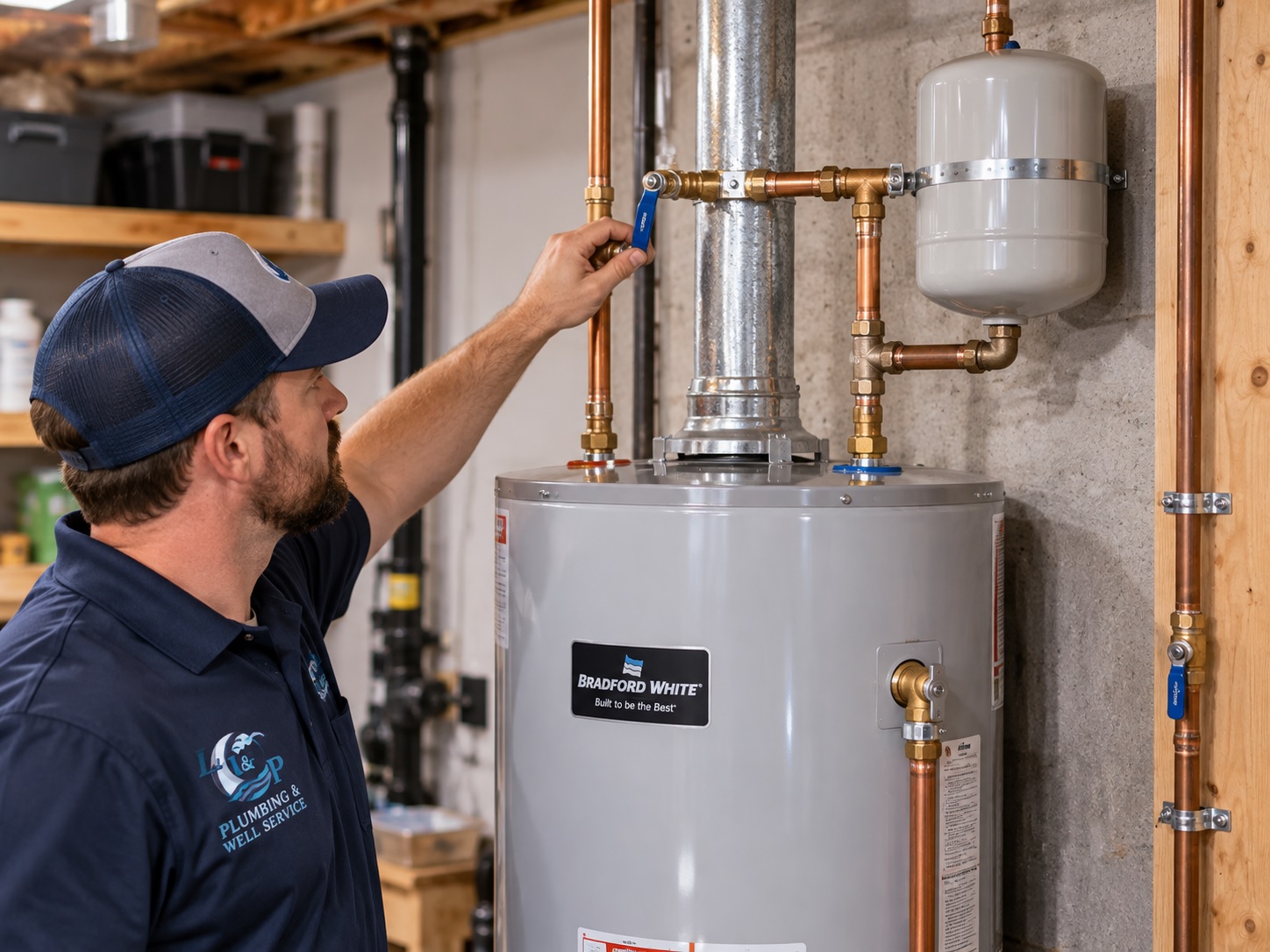
A water heater expansion tank helps control pressure created when heated water expands inside a closed plumbing system. Homes with a check valve, backflow preventer, or pressure-reducing valve may require thermal expansion control. When an expansion tank fails or is incorrectly sized, homeowners may notice pressure fluctuations, relief-valve discharge, leaking fixtures, or added stress on plumbing components.
A water heater expansion tank may look like a small accessory mounted near the heater, but its job is important. It helps manage pressure changes that occur when water heats and expands.
For homeowners in Watertown, Litchfield County, and New Haven County, understanding this component can make water-heater problems easier to diagnose.
What Is a Water Heater Expansion Tank?
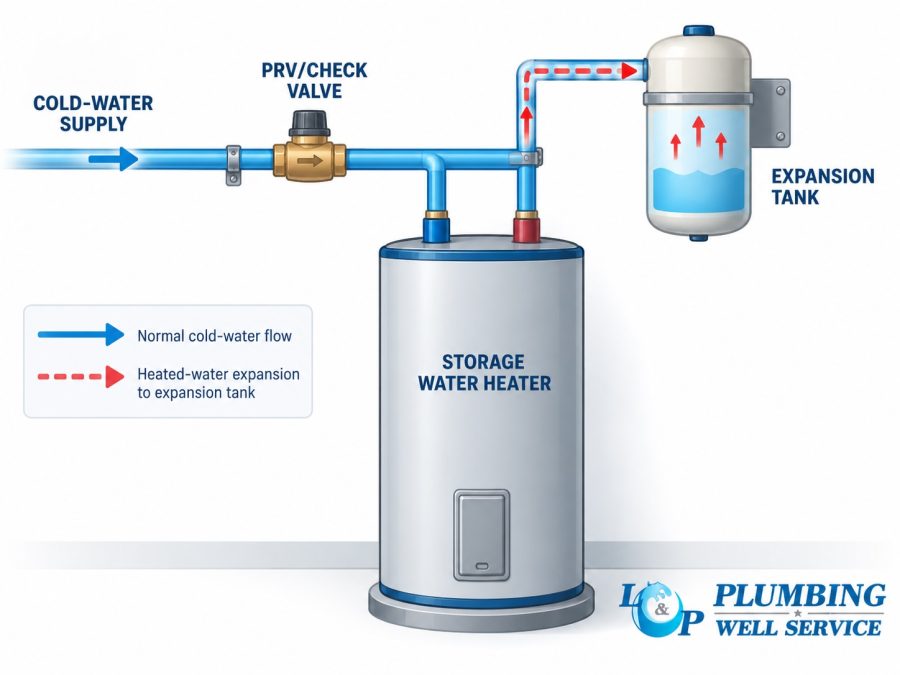
A thermal expansion tank is a small pressure-control vessel connected to the cold-water piping serving a storage water heater.
Inside the tank, an air cushion is separated from system water by a diaphragm or bladder.
As water heats:
- Water expands.
- Some of that increased volume enters the expansion tank.
- The air chamber compresses.
- The tank provides temporary space for the expanded water.
- Pressure is kept from rising as sharply throughout the plumbing system.
The expansion tank does not heat water. Its purpose is pressure control.
Why Does Water Pressure Increase When Water Heats Up?
Water expands slightly as its temperature rises.
In an open plumbing system, some of that added volume may move backward toward the public water supply. In a closed system, certain components prevent reverse flow.
These may include:
- Check valves
- Backflow preventers
- Pressure-reducing valves
When water cannot move backward, the expanding volume has nowhere to go. System pressure can then increase during the heating cycle.
The 2021 International Plumbing Code addresses this situation by requiring thermal expansion control where a storage water heater receives cold water through a check valve, pressure-reducing valve, or backflow preventer.
Does Every Water Heater Need an Expansion Tank?
No. Whether thermal expansion control is needed depends on the plumbing system, not simply the presence of a water heater.
The main question is whether the water system is effectively closed.
Factors can include:
- A check valve at the water service
- Backflow prevention equipment
- A pressure-reducing valve
- Utility-side equipment
- Water-heater type
- Existing thermal expansion control
- Applicable code requirements
A licensed plumber can determine whether the system needs an expansion tank or another approved thermal expansion-control method.
Is a Water Heater Expansion Tank Required in Connecticut?
Certain Connecticut plumbing systems require thermal expansion control, but it is not accurate to say every Connecticut water heater must have an expansion tank.
As of September 22, 2026, Connecticut still lists the 2022 Connecticut State Building Code as the current code. That code is based on the 2021 International Codes, including the 2021 International Plumbing Code. Connecticut has stated that adoption of the proposed 2026 code has been delayed pending further approval.
IPC Section 607.3 requires thermal expansion control when a storage water heater’s cold-water supply passes through a check valve, pressure-reducing valve, or backflow preventer.
The exact installation should still be evaluated against the applicable code, plumbing configuration, and local permit requirements.
What Are the Signs of a Bad Expansion Tank?
Possible bad expansion tank symptoms include:
- Expansion tank dripping or leaking
- Water leaking around the tank connection
- Frequent T&P relief-valve discharge
- Sudden pressure changes
- Fixtures dripping after hot-water cycles
- Pressure-related banging or plumbing noises
- Corrosion around the tank or fitting
- A tank that feels unusually heavy
These symptoms do not prove the expansion tank is the cause.
High incoming pressure, a failing pressure-reducing valve, incorrect tank sizing, a defective relief valve, or another plumbing problem can create similar symptoms.
Diagnosis matters more than simply matching one symptom to one part.
Why Is My Water Heater Expansion Tank Leaking?
The location of the leak can help narrow down the problem.
Leak From the Threaded Connection
Possible causes include a loose connection, corrosion, failed fitting, or installation problem.
Leak From the Tank Body
A leak through the shell may indicate internal corrosion, tank deterioration, or physical failure.
Water at the Air Valve
Water appearing at the air valve can indicate failure of the internal diaphragm or bladder.
Expansion tank pressure and plumbing-system pressure need to work together, so we recommend having the system evaluated rather than disassembling or repressurizing the tank without proper testing.
Can a Bad Expansion Tank Cause High Water Pressure?
A failed or improperly functioning expansion tank can allow pressure to rise during water-heating cycles in a closed system.
However, persistent high pressure may also come from:
- A failing pressure-reducing valve
- High municipal pressure
- Incorrect expansion-tank charge
- Incorrect tank sizing
- Thermal expansion
- Plumbing configuration
The whole pressure-control system should be checked before replacing parts.
Expansion Tank vs. Pressure-Reducing Valve
These components perform different jobs.
| Component | Main Job |
|---|---|
| Expansion tank | Absorbs increased water volume caused by thermal expansion |
| Pressure-reducing valve | Reduces high incoming water-supply pressure |
| T&P relief valve | Emergency safety device for excessive temperature or pressure |
| Backflow preventer | Prevents unwanted reverse flow |
A pressure-reducing valve does not replace an expansion tank, and an expansion tank does not replace a PRV.
Expansion Tank vs. T&P Relief Valve
An expansion tank handles normal thermal expansion.
The temperature-and-pressure relief valve is an emergency safety device.
A T&P valve that repeatedly discharges should not be treated as the normal method of controlling thermal expansion. The cause of the pressure condition should be identified.
Never cap, plug, or disable a relief valve.
How Is an Expansion Tank Sized?
Expansion tank sizing depends on factors such as:
- Water-heater capacity
- Incoming water pressure
- System configuration
- Manufacturer specifications
The 2021 IPC requires thermal expansion tanks to be sized according to the manufacturer’s instructions so system pressure remains within permitted limits.
That is why we avoid simple rules such as assigning one expansion-tank size to every 40-gallon or 50-gallon water heater.
Where Is a Water Heater Expansion Tank Installed?
For systems covered by IPC Section 607.3, the thermal expansion-control device is connected to the cold-water supply downstream of check valves, pressure-reducing valves, and backflow preventers.
Proper installation also depends on:
- Correct tank support
- System pressure
- Tank sizing
- Approved fittings
- Correct location
- Leak testing
This is not simply a matter of attaching the tank to any nearby pipe.
Should the Expansion Tank Be Replaced With the Water Heater?
Not automatically.
Replacement may make sense when the existing tank is leaking, corroded, failed internally, incorrectly sized, improperly charged, or no longer appropriate for the current plumbing configuration.
When replacing a water heater, we recommend checking the condition of the expansion tank and pressure-control system at the same time.
For professional water heater repair and installation, L&P Plumbing & Well Service can evaluate the complete system rather than treating the heater as an isolated appliance.
Why Expansion Tanks Matter More Than Their Size Suggests
A properly functioning expansion tank can help reduce unnecessary pressure stress on:
- Water heaters
- Faucet cartridges
- Toilet fill valves
- Supply lines
- Shutoff valves
- Plumbing fittings
- Other pressure-sensitive components
That makes thermal expansion control part of overall plumbing-system longevity.
Have L&P Check the Whole Water-Heater System
An expansion tank should not be diagnosed by itself.
If the tank leaks, the T&P relief valve discharges, or household pressure changes during heating cycles, the underlying cause may involve the expansion tank, water heater, PRV, backflow equipment, or incoming pressure.
L&P Plumbing & Well Service provides water-heater troubleshooting, repair, replacement, and installation throughout Watertown and surrounding Connecticut communities.
Frequently Asked Questions
Does every water heater need an expansion tank?
No. The need depends on the plumbing configuration, especially whether a check valve, PRV, backflow preventer, or similar device creates a closed system.
How can we tell if a water heater expansion tank is bad?
Possible signs include leakage, corrosion, pressure fluctuations, repeated T&P valve discharge, or internal diaphragm failure. Similar symptoms can have other causes, so testing is recommended.
Can a bad expansion tank damage a water heater?
Uncontrolled thermal expansion can increase stress on the water heater and other plumbing components. The expansion tank helps manage that pressure where thermal expansion control is required.
Why is water coming out of the expansion tank?
The source may be a failed fitting, corrosion, tank-body failure, or damaged internal diaphragm. The leak location should be identified before replacing parts.
Is a water heater expansion tank required in Connecticut?
Connecticut currently uses the 2022 State Building Code, based on the 2021 International Codes. Under IPC Section 607.3, applicable closed storage-water-heater systems require thermal expansion control.