
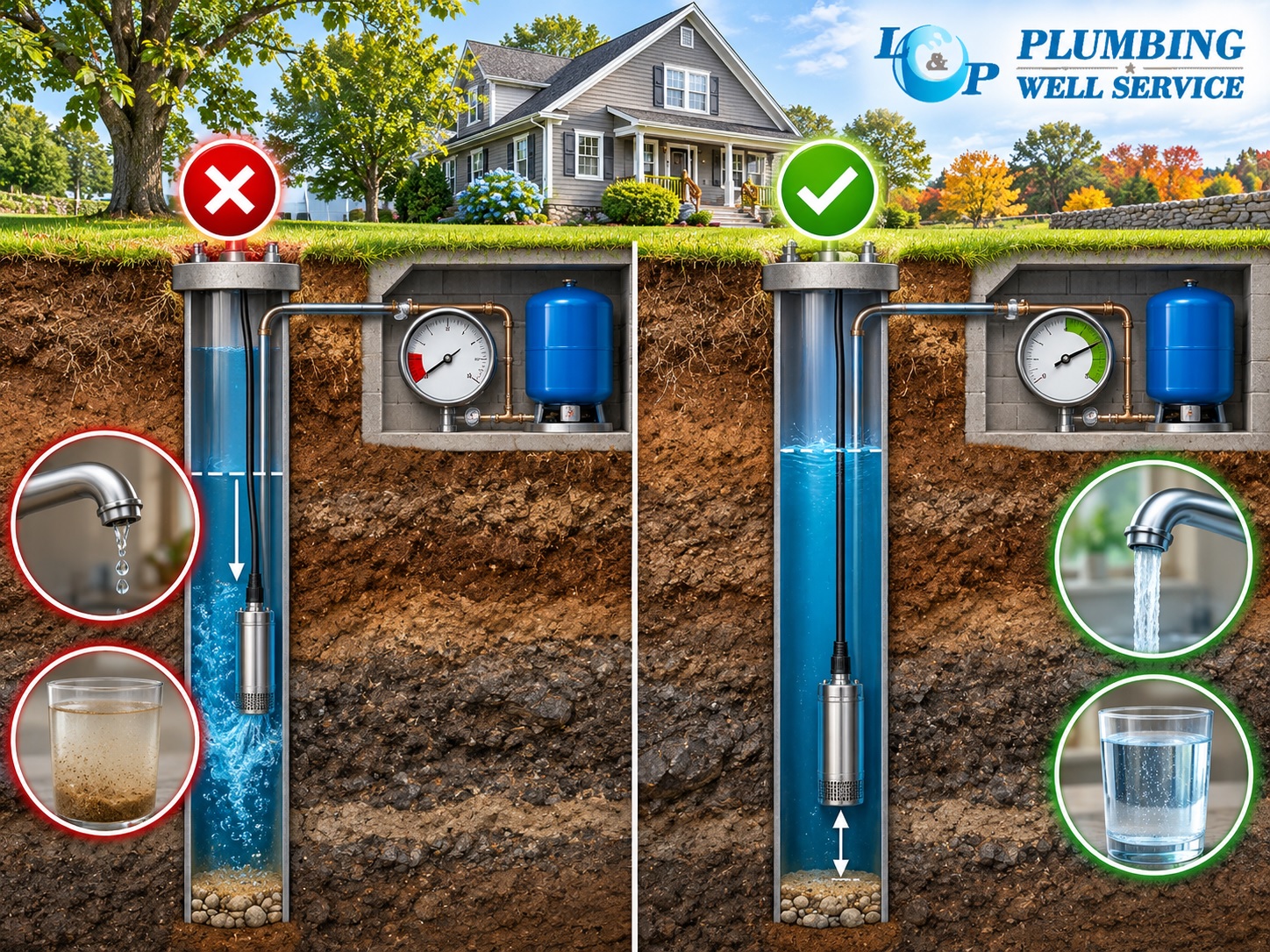
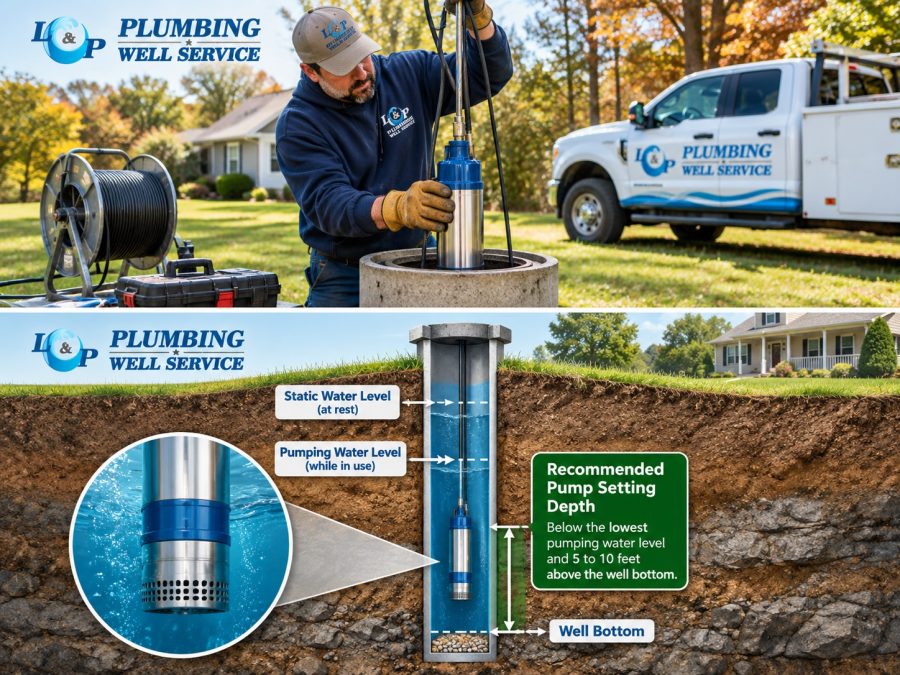
A submersible well pump should be installed below the lowest expected pumping water level, with enough clearance above the well bottom to avoid sediment. A common guideline is to keep the pump approximately 5 to 10 feet above the bottom, although the correct well pump depth depends on total well depth, water yield, drawdown, and manufacturer requirements. For Connecticut homeowners, professional testing helps determine a safe, reliable pump setting depth.
What Determines the Correct Well Pump Depth?
A well that extends 300 feet underground does not necessarily need a pump installed at 300 feet. The goal is to position the pump where it remains submerged while avoiding sediment and excessive wear.
At L&P Plumbing & Well Service, we evaluate several factors before recommending a pump setting depth:
- Total well depth: The distance from ground level to the bottom of the well.
- Static water level: The depth at which water naturally rests when the pump is off.
- Pumping water level: The water level while the pump is operating.
- Well recovery rate: How quickly groundwater replenishes the well.
- Sediment conditions: The potential for sand, silt, and debris to enter the pump.
These measurements help us select a suitable installation depth rather than relying on well depth alone.
How Deep Should a Submersible Pump Be Installed?
A submersible pump depth must provide enough water above the pump to maintain reliable operation during household water demand.
Consider a hypothetical Connecticut well with the following measurements:
| Well Measurement | Example |
|---|---|
| Total well depth | 250 feet |
| Static water level | 60 feet |
| Pumping water level | 150 feet |
| Potential pump setting | 190 feet |
In this example, a pump set at 190 feet would sit approximately 40 feet below the measured pumping water level and 60 feet above the well bottom.
However, this is an illustration, not an installation recommendation. The actual setting also depends on seasonal water changes, pump specifications, intake positioning, and motor cooling requirements.
Why Installing a Pump Too Deep Can Be a Problem
Placing a pump too close to the well bottom may expose the system to accumulated sediment.
Potential problems include:
- Sand entering the pump intake
- Premature wear on pump components
- Cloudy or gritty household water
- Reduced pumping efficiency
- Increased maintenance requirements
We recommend identifying the source of sediment before changing pump placement. Our related article, Sand in Well Water: Causes, Pump Damage & Fixes, explains how sediment can affect Connecticut well systems.
What Happens When a Well Pump Is Set Too Shallow?
A pump installed above the lowest pumping water level can lose its water supply during extended use.
Warning signs may include fluctuating pressure, intermittent water flow, air entering the plumbing, or a sudden loss of water.
Insufficient submergence can also contribute to overheating and pump damage.
The solution is not always to lower the pump. We first need to determine whether the underlying problem is insufficient well yield, excessive pumping demand, or an equipment malfunction.
Does a Deep Well Pump Need to Be at the Bottom?
No. A deep well pump generally operates while suspended above the bottom of the well.
For many submersible installations, manufacturer recommendations call for several feet of bottom clearance, commonly around 5 to 10 feet.
However, the pump also needs sufficient submergence below the pumping water level. Some installations require additional attention to water flow around the motor for adequate cooling.
A deeper installation is not automatically better. The correct balance depends on the well’s construction and operating conditions.
How Do Connecticut Well Conditions Affect Pump Setting Depth?
Groundwater conditions can vary across Watertown, Litchfield County, and surrounding Connecticut communities.
A well with strong recovery may maintain a relatively stable pumping water level, while a low-yield well may experience substantial drawdown during extended water use.
Seasonal changes can also affect available water.
For homeowners experiencing declining water pressure or intermittent supply, we recommend evaluating the well’s performance before assuming the pump needs to be lowered.
The Connecticut Department of Public Health recommends using appropriately licensed contractors for well pump maintenance and repairs.
Signs Your Well Pump May Need Repositioning
Improper pump placement can sometimes contribute to water system problems.
Watch for these symptoms:
- Water pressure drops during extended use. The pumping water level may be approaching the pump intake.
- Sand or sediment appears in faucets. The pump may be drawing particles from the well.
- Water stops and later returns. The well may be temporarily unable to keep up with demand.
- The pump runs excessively. The system may be struggling with low yield, pressure problems, or equipment failure.
These symptoms do not automatically indicate incorrect pump depth. Professional testing is needed to identify the cause.
Frequently Asked Questions
How far below the water level should a submersible pump be?
The pump should remain below the lowest expected pumping water level. Some installation guidance specifies at least 3 feet of submergence below maximum drawdown, but additional clearance may be necessary depending on the pump and well conditions.
Can a well pump be lowered to get more water?
Sometimes lowering a pump provides access to a greater water reserve. However, it does not increase the well’s natural recharge rate. The well must have sufficient depth, suitable construction, and an appropriate pumping system.
Does installing a pump deeper increase water pressure?
Not necessarily. Household water pressure depends on pump performance, pumping water level, elevation, piping losses, and pressure system settings. Lowering a pump alone does not guarantee stronger pressure.
Get Professional Well Pump Installation in Watertown, CT
The right well pump depth protects your equipment and helps maintain dependable household water.
At L&P Plumbing & Well Service, we provide professional well pump installation, troubleshooting, and replacement services throughout Watertown, Litchfield County, and surrounding Connecticut communities.
Whether your well is experiencing low pressure, sediment problems, or inconsistent water delivery, our team can evaluate the system and recommend the appropriate solution.