
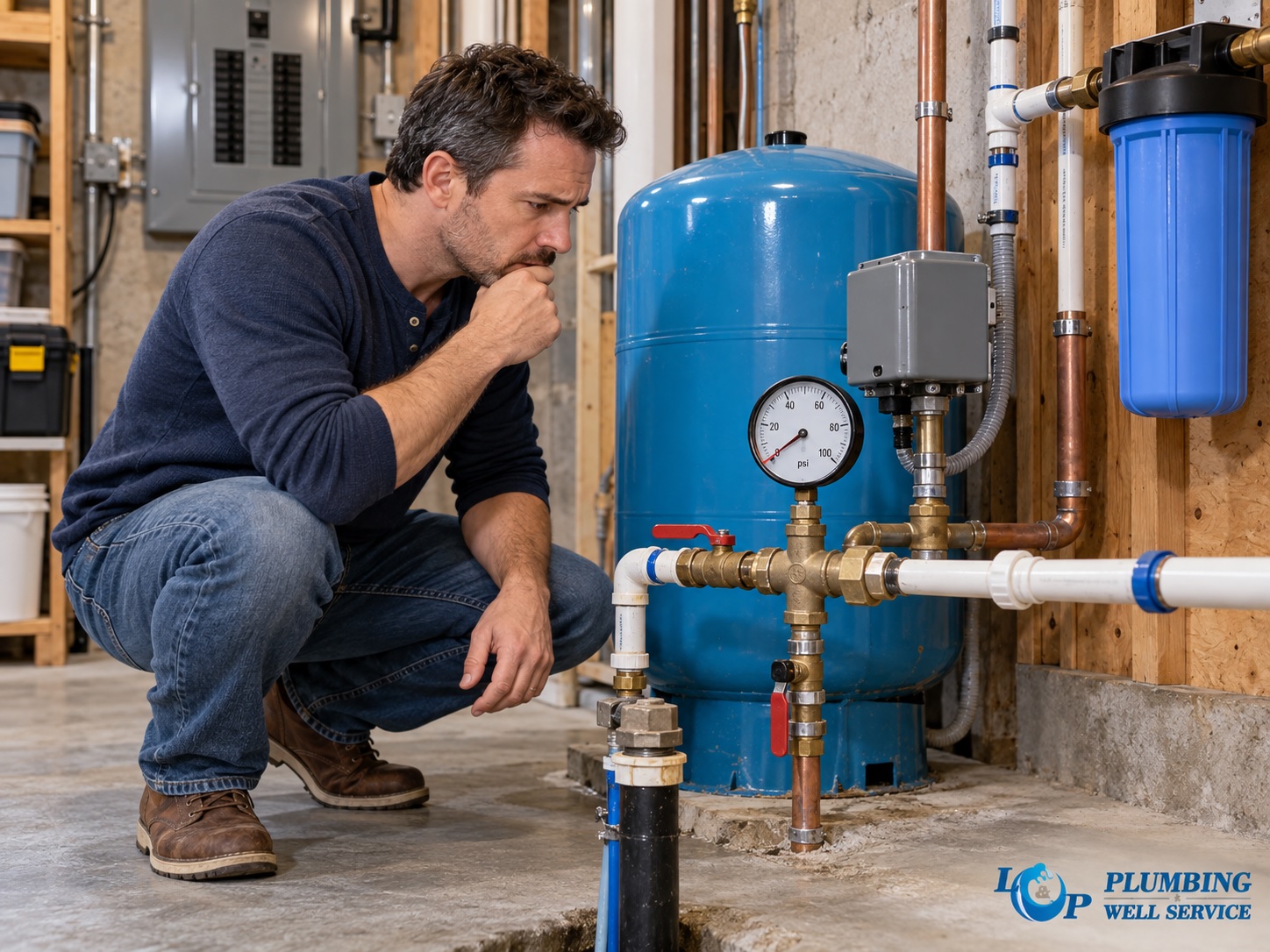
When a well pump is not working, start with the safest checks: confirm the whole house has lost water, check the dedicated pump breaker, look at the pressure gauge, verify accessible shutoff valves are open, and listen for unusual sounds. A tripped breaker can stop a pump completely, while a pressure switch, control problem, failed motor, low well level, or damaged wiring can also cause a well pump that won’t start. The Water Systems Council lists blown breakers, low voltage, wiring problems, defective motors, and pressure-switch problems among common causes of pumps that fail to start.
At L&P Plumbing & Well Service, we recommend stopping after the basic homeowner checks. Well pump controls can carry dangerous electrical voltage, so electrical testing and pressure-switch repairs are jobs for a qualified professional.
Why Won’t My Well Pump Turn On?
A loss of water does not automatically mean the pump itself has failed.
A private well system relies on several components working together. The pump supplies the water, the pressure switch controls when the pump starts and stops, the pressure tank stores pressurized water, and electrical controls supply power to the system.
A failure anywhere along that chain can create the same frustrating result: a faucet opens and nothing comes out.
Common causes include a tripped breaker, failed pressure switch, damaged pump motor, faulty control box, broken wiring, low water level, plumbing restriction, or closed valve.
Before scheduling a repair, several safe checks can help narrow down the problem.
1. Confirm the Whole House Has No Water
Check more than one fixture before assuming the pump has stopped.
Try a kitchen faucet, bathroom sink, shower, and outdoor spigot. When only one fixture has no water, the problem may be isolated to that faucet or branch of plumbing.
When every fixture is dry, the no water well pump problem is more likely connected to the well system, pressure controls, supply line, or main plumbing.
2. Check the Well Pump Breaker
Most well pumps have a dedicated circuit breaker.
Look for a breaker labeled well, pump, water pump, or something similar. If the breaker has tripped, switch it fully off and then back on one time.
If it trips again, stop resetting it.
Repeated breaker trips can indicate wiring trouble, a short circuit, a failing motor, or another electrical problem. The Water Systems Council identifies blown fuses or tripped circuit breakers as one of the first items to check when a pump will not start.
3. Look at the Pressure Gauge
The pressure gauge near the pressure tank can provide valuable clues without requiring electrical work.
Many residential systems operate within ranges such as 30/50 PSI or 40/60 PSI. The pressure switch normally starts the pump at the lower setting and stops it after the system reaches the upper setting.
A gauge at or near zero with no pump response may point toward a power, switch, control, wiring, or pump problem.
Pressure on the gauge but no water at fixtures can suggest a closed valve, clogged filter, frozen pipe, or another restriction farther into the home’s plumbing.
4. Check Accessible Water Valves
A valve can occasionally be left closed after filter maintenance, plumbing repairs, water heater work, or basement service.
Look at accessible valves near the pressure tank and filtration equipment. Confirm that the home’s main well-water valve has not been accidentally shut.
Never force an old or stuck valve. A damaged valve can begin leaking or break internally.
5. Listen for the Pump or Controls
Different sounds can help us understand what the system may be doing.
A completely silent system may have lost power or have a control problem. Clicking near the pressure switch without the pump starting can suggest a switch, wiring, motor, or control issue. Humming without water production can also point toward an electrical or mechanical problem.
A pump that runs continuously creates a different concern. We cover that problem in our related guide, Well Pump Running Continuously? 5 Causes and Warning Signs. Continued operation without adequate water or pressure can damage pump components.
6. Think About Recent Water Use
Sometimes a pump appears to have failed because the well temporarily cannot keep up with demand.
Heavy water use from showers, laundry, irrigation, filling a pool, or several appliances running together may draw down a low-yield well faster than it can recover.
If water disappeared after unusually heavy use, low well yield could be part of the problem.
Avoid repeatedly cycling the pump in an attempt to force water back into the home. A pump operating under poor-water conditions can experience additional stress.
7. Know What Not to Touch
Homeowners can safely look at gauges, breakers, visible valves, and obvious leaks. We do not recommend removing pressure-switch covers, testing live terminals, opening control boxes, or attempting pump wiring repairs without proper electrical training.
The Water Systems Council’s professional troubleshooting guidance specifically calls for circuits to be de-energized, locked out, and verified before electrical components or wiring are serviced.
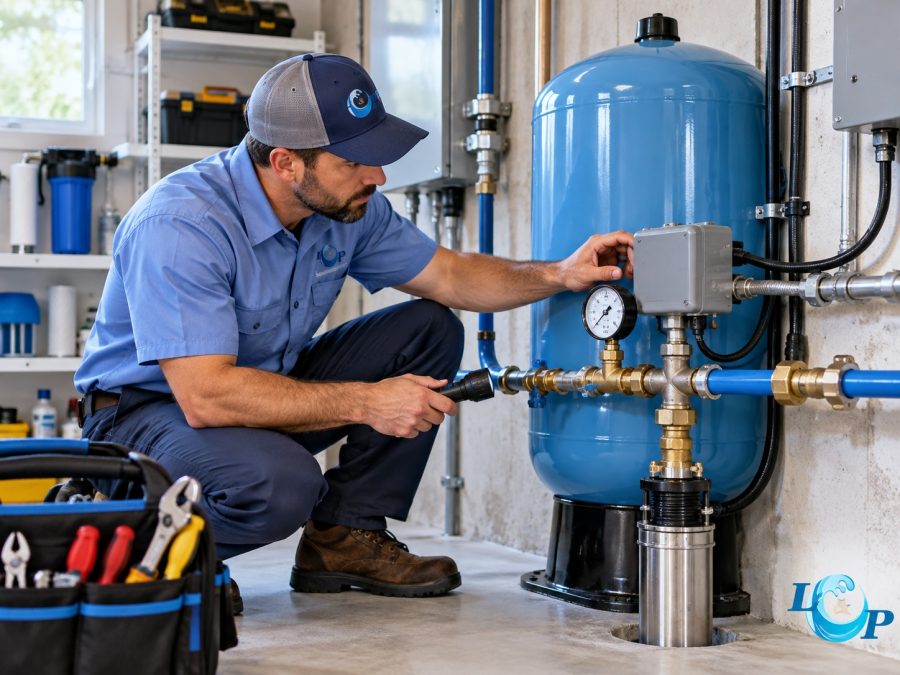
Safe homeowner checks include:
- Confirming whether every fixture has lost water
- Resetting a tripped pump breaker once
- Reading the pressure gauge
- Checking accessible shutoff valves
- Looking for visible water leaks
- Listening for clicking, humming, or continuous pump operation
Electrical testing should come next only with proper equipment and experience.
When Should We Call for Well Pump Service?
Call for service when the breaker trips repeatedly, the gauge remains at zero, there is a burning smell, electrical components are hot, the pump hums without producing water, the home repeatedly loses water, or basic checks do not restore service.
Our well pump repair service in Watertown, CT covers submersible pumps, jet pumps, pressure switches, pressure tanks, wiring issues, water lines, and complete well-system diagnosis.
At L&P Plumbing & Well Service, we test the system before recommending replacement. A well pump that won’t start may need a relatively small control repair rather than a new pump.
When there is no water and the well pump is not working, start with the safe checks, avoid live electrical components, and get the system diagnosed before a manageable failure becomes a larger repair.