
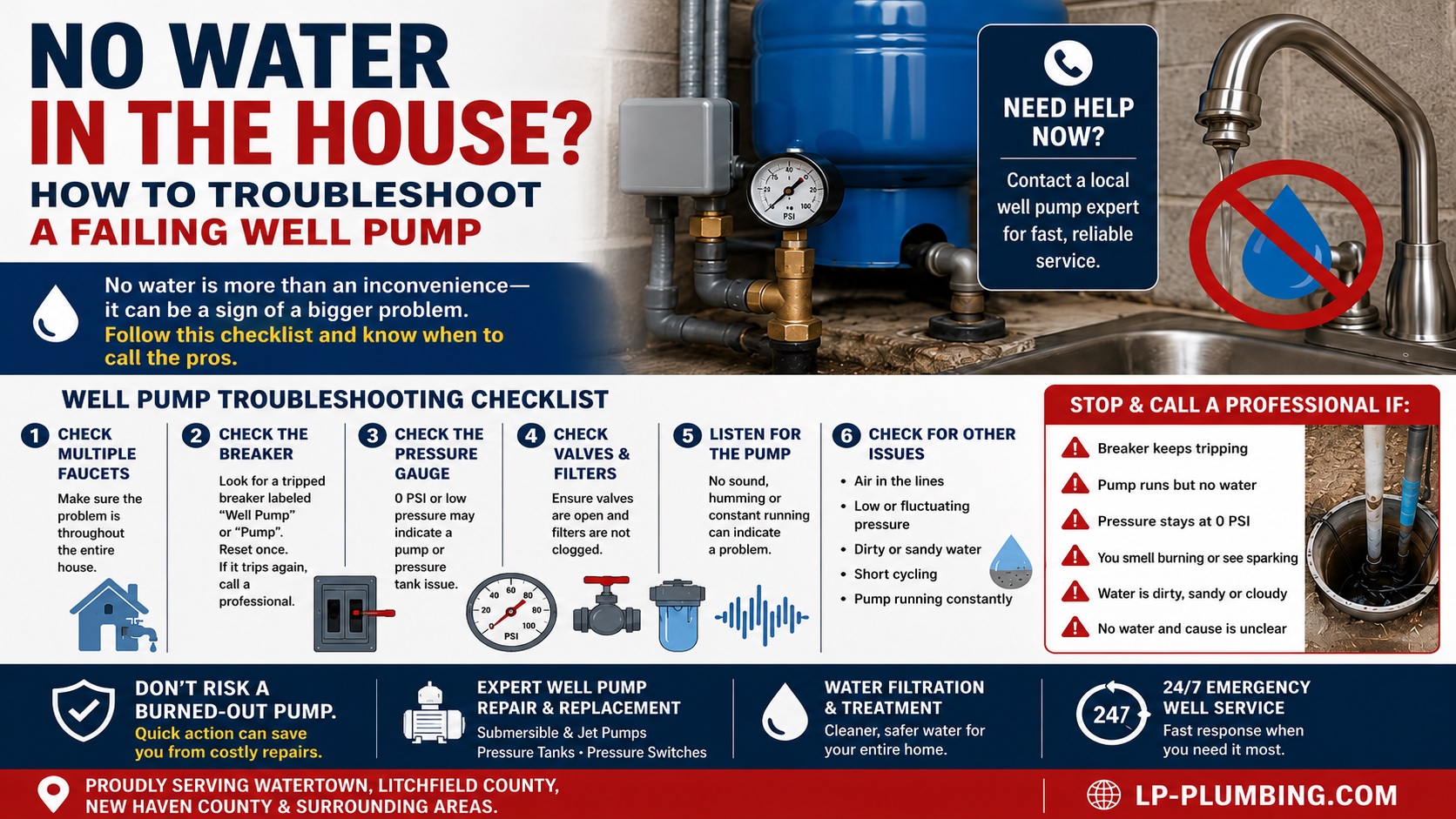
Turning on a faucet and getting no water is one of the most stressful problems a homeowner can face. When a home depends on a private well, the issue may come from the breaker, pressure switch, pressure tank, control box, well pump, underground line, or the well itself.
At L&P Plumbing & Well Service, we help homeowners in Watertown, Litchfield County, New Haven County, and nearby Connecticut communities restore water quickly and safely. Our licensed team handles well pump repair, well pump replacement, well pump installation, pressure tanks, pressure switches, water filtration, and complete well water systems.
This guide walks through a safe first-response checklist for homeowners searching no water in house from well, well pump troubleshooting, submersible well pump replacement cost, or well water pump repair near me.
First Step: Stay Calm and Protect the Pump
A no-water situation feels urgent because the whole home stops working. Toilets, showers, sinks, washing machines, dishwashers, and water heaters all depend on steady water supply.
Before checking anything, turn off major water-using appliances. Do not keep opening faucets for long periods if no water is coming out. If the pump is running but not producing water, continued operation can overheat or damage the motor.
A submersible pump is designed to run with water around it. When something prevents proper water delivery, the motor can be placed under severe stress. That is why quick shutdown and professional diagnosis matter.
Step 1: Confirm the Problem Is Whole-House
Start by checking more than one fixture.
Check:
- Kitchen sink
- Bathroom sink
- Shower or tub
- Outdoor spigot
- Laundry connection
- Basement utility sink, if present
If only one faucet has no water, the issue may be local to that fixture. If the entire home has no water, the issue is more likely tied to the well pump system, pressure tank, main supply line, or electrical controls.
Step 2: Check the Breaker Panel
Many well pumps are powered by a dedicated breaker. A tripped breaker can shut the pump off completely.
Go to the electrical panel and look for a breaker labeled:
- Well pump
- Pump
- Water pump
- Well
- Pressure pump
If the breaker is tripped, reset it once by switching it fully off, then back on. If it trips again, stop. Repeated resetting can create electrical risk and may point to a short, bad motor, control issue, wiring problem, or failing pump.
This is the point where it is safer to call a licensed professional. L&P Plumbing & Well Service provides well pump repair in Watertown, CT for no water, low pressure, air in lines, pump cycling, pressure switch issues, pressure tank issues, and complete well system problems.
Step 3: Look at the Pressure Gauge
Most well systems have a pressure tank with a pressure gauge nearby. A normal residential system often operates within a set pressure range, such as 30/50 PSI or 40/60 PSI, depending on the system.
Look at the gauge without touching electrical parts.
If the gauge reads 0 PSI
The tank has no usable pressure. The pump may not be turning on, the pressure switch may not be calling for water, the breaker may be off, or the pump may have failed.
If the gauge has pressure but faucets have no water
There may be a closed valve, blocked filter, frozen pipe, clogged line, or plumbing restriction after the tank.
If pressure is low and dropping
The pump may be struggling, the well may be producing slowly, the pressure tank may be failing, or there may be a leak in the system.
L&P Plumbing notes that well pump problems can show up as no water, intermittent water, low or fluctuating pressure, constant running, short cycling, air in lines, or pressure tank issues.
Step 4: Check for an Accidentally Closed Valve
Sometimes a no-water call starts with a valve that was accidentally turned off during filter service, plumbing work, water heater work, or basement cleanup.
Look near the pressure tank and filtration equipment for main water shutoff valves. Make sure the valve handle is open.
Do not force a stuck valve. Older valves can break, leak, or fail internally.
Step 5: Check the Pressure Switch Area, But Do Not Touch Live Electrical Parts
The pressure switch tells the pump when to turn on and off. It is usually located near the pressure tank. When pressure drops, the switch should activate the pump. When pressure reaches the cut-off setting, the switch shuts the pump off.
A failed or clogged pressure switch can cause no water even when the pump itself is still functional.
Warning signs near the switch include:
- Burn marks
- Clicking but no pump response
- Corrosion
- Insects or debris inside the cover
- Loose wiring
- Repeated breaker trips
- A switch that will not engage
- Pump short cycling
Do not remove covers or touch wiring unless power is off and the work is within your skill level. Well systems often involve high-voltage electrical components. If there is sparking, burning smell, heat, humming, or repeated tripping, stop and call a licensed professional.
Step 6: Listen for the Pump
In some homes, the pump or control equipment can be heard when it starts. A submersible pump is located inside the well, so it may be hard to hear. A jet pump is usually above ground and easier to hear.
Possible clues:
- No sound at all may point to a power, switch, control, or motor issue.
- A humming sound may point to a motor or electrical problem.
- A pump that runs constantly may point to a leak, bad pressure tank, failing pump, or low well yield.
- Rapid on and off cycling may point to pressure tank or switch problems.
Do not let a pump run continuously without water. That can lead to overheating and may turn a repairable issue into a full replacement.
Step 7: Check Water Filtration Equipment
If the pressure gauge shows pressure but little or no water reaches the fixtures, the blockage may be after the pressure tank.
Common restriction points include:
- Sediment filter
- Iron filter
- Water softener
- Carbon filter
- UV system plumbing
- Bypass valve
- Clogged cartridge filter
- Shutoff valve near filtration equipment
L&P Plumbing & Well Service provides well water filtration and water treatment services in Watertown, CT, including filter changes, system cleaning, UV lamp replacement, water pressure checks, bacterial testing, well pump inspection, and emergency repairs for sudden water issues.
Step 8: Watch for Signs of a Failing Pressure Tank
A failing pressure tank can make a well pump work too hard. When the tank cannot hold proper air pressure or the internal bladder fails, the pump may short cycle. Short cycling means the pump turns on and off too frequently, which can shorten pump life.
Signs of pressure tank trouble include:
- Pump clicking on and off rapidly
- Pressure that rises and falls quickly
- Water pressure surges
- Air sputtering at faucets
- Condensation or rust on the tank
- Waterlogged tank symptoms
- Pump running more often than normal
Pressure tank issues should be diagnosed before assuming the pump itself has failed. L&P Plumbing’s well pump replacement service notes that pressure tank problems can continue causing water pressure issues even after a new pump if the tank is not tested.
Step 9: Consider the Well Pump Age and Symptoms
Some well pump failures happen suddenly. Others develop over time.
A failing well pump may cause:
- No water at all
- Low water pressure
- Fluctuating pressure
- Pump runs constantly
- Pump short cycles
- Air sputters from faucets
- Dirty, cloudy, or sandy water
- Breaker trips repeatedly
- Higher electric bills
- Water returns briefly, then stops again
L&P Plumbing provides well pump replacement for submersible pumps, jet pumps, deep-well systems, and full water delivery systems when repair is no longer the best long-term option.
Step 10: Know When to Stop Troubleshooting
Some quick checks are safe for homeowners. Others are not worth the risk.
Call a licensed professional right away if:
- The breaker keeps tripping
- There is a burning smell
- The pump hums but does not deliver water
- The pump runs nonstop
- Pressure stays at 0 PSI
- Water comes back briefly, then fails again
- There is air sputtering from multiple fixtures
- Water is sandy, muddy, or cloudy
- Electrical components look damaged
- The pressure switch is corroded or burnt
- The home has no water and the cause is unclear
Private well owners are responsible for the safety and quality of their own drinking water, and EPA notes that private wells are not regulated by the federal government under the Safe Drinking Water Act in the same way as public water systems.
Why Professional Well Pump Troubleshooting Matters
A no-water outage can have several causes that look similar from the homeowner’s perspective. The wrong repair can waste money and leave the home without reliable water.
Professional troubleshooting can check:
- Electrical supply
- Breaker performance
- Pressure switch operation
- Pressure tank condition
- Pump control box
- Pump amperage draw
- Well pump performance
- Water line leaks
- Clogged filters
- Well yield concerns
- Check valve problems
- Sediment or water quality issues
What About Submersible Well Pump Replacement Cost?
Many homeowners search submersible well pump replacement cost as soon as the water stops. The honest answer is that cost depends on the system.
Pricing can vary based on:
- Well depth
- Pump horsepower
- Pump type
- Wire condition
- Drop pipe condition
- Pressure tank condition
- Control box needs
- Accessibility
- Emergency service timing
- Water line condition
- Whether the old pump must be pulled from the well
A professional diagnosis is important because not every no-water issue means the submersible pump has failed. Sometimes the problem is a pressure switch, pressure tank, clogged filter, control box, breaker, or wiring issue.
L&P Plumbing focuses on fast diagnostics, fair pricing, and high-quality replacement pumps when replacement is needed.
Why Delaying Service Can Make the Problem Worse
When a well pump system struggles, waiting can increase the damage.
Delaying service may lead to:
- Burned-out pump motor
- Damaged pressure switch
- Premature pressure tank failure
- Overheated electrical components
- Loss of water for the whole home
- More expensive emergency repairs
- Sediment entering filters and fixtures
- Water heater problems if the system runs dry
If there is no water in the house from a well, the best move is to do the basic safe checks, then call for professional help before the pump is damaged further.
Local Well Pump Repair Near Watertown CT
When homeowners search well water pump repair near me, they need fast help from a local company that understands Connecticut well systems.
L&P Plumbing & Well Service is based in Watertown, CT and serves surrounding communities including Bethlehem, Goshen, Harwinton, Litchfield, Middlebury, New Hartford, Torrington, Winchester, Wolcott, Woodbury, Waterbury, Burlington, Thomaston, and nearby areas.
Our services include:
- Well pump repair
- Well pump replacement
- Well pump installation
- Well pump maintenance
- Pressure tank service
- Pressure switch repair
- Water filtration
- Water treatment
- General plumbing
- Emergency plumbing support
Emergency No-Water Checklist
Use this quick checklist before calling:
- Check multiple faucets.
- Turn off water-using appliances.
- Check the well pump breaker once.
- Do not keep resetting a tripping breaker.
- Check the pressure gauge.
- Look for closed valves.
- Check whether filtration equipment is bypassed or clogged.
- Listen for unusual pump sounds.
- Stop if there is burning smell, humming, sparking, or repeated tripping.
- Call L&P Plumbing & Well Service for professional diagnosis.
Do Not Risk Burning Out the Pump
A no-water problem can sometimes have a simple cause, but it can also be the first sign of a failing pump, pressure switch, pressure tank, control box, or water line. The safest approach is to check the basics, avoid repeated resets, and call a licensed professional before the system suffers more damage.
At L&P Plumbing & Well Service, we help homeowners get water restored safely with clear diagnostics, honest recommendations, and dependable well pump service.
For urgent help, call L&P Plumbing & Well Service.
FAQs About Well Pump Troubleshooting
Why is there no water in the house from the well?
No water in the house from a well can be caused by a tripped breaker, failed pressure switch, bad pressure tank, clogged filter, closed valve, broken water line, low well yield, failed control box, or failing well pump.
What should homeowners check first when the well has no water?
Start by checking multiple faucets, then check the breaker panel, pressure gauge, shutoff valves, and filtration equipment. If the breaker trips again or pressure stays at 0 PSI, call a licensed professional.
Can a bad pressure switch cause no water?
Yes. A failed, clogged, corroded, or burned pressure switch can prevent the pump from turning on. Because pressure switches involve electrical components, professional repair is recommended when damage is visible or the cause is unclear.
Should the breaker be reset if the well pump stops working?
A tripped breaker can be reset once. If it trips again, stop. Repeated resetting can damage equipment and may indicate a serious electrical or pump problem.
How do homeowners know if a submersible well pump is failing?
Signs include no water, low pressure, short cycling, air sputtering, dirty water, pump running constantly, repeated breaker trips, or pressure staying at 0 PSI. A professional test can confirm whether the pump is failing.
What affects submersible well pump replacement cost?
Submersible well pump replacement cost depends on well depth, pump size, equipment type, wire condition, pressure tank condition, access, emergency timing, and whether related components need replacement.
Does L&P Plumbing & Well Service offer well water pump repair near Watertown CT?
Yes. L&P Plumbing & Well Service provides well pump repair, replacement, installation, maintenance, pressure tank service, water filtration, and emergency well system support in Watertown and nearby Connecticut communities.