
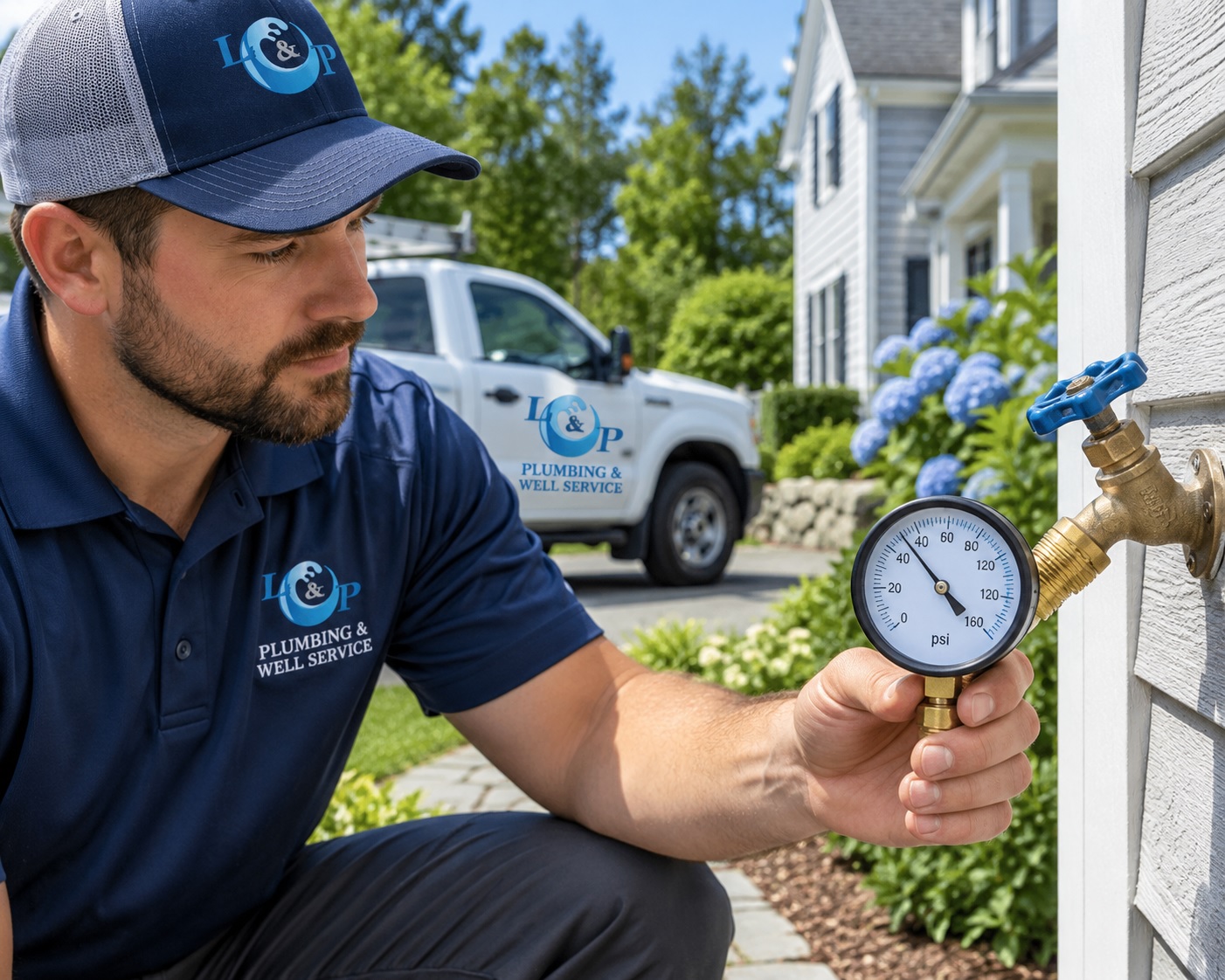
Normal water pressure for a house is generally between 40 and 60 PSI, with 45 to 60 PSI recommended by the U.S. Environmental Protection Agency for efficient household water use. A reading of 40 PSI may be acceptable, while 60 PSI typically provides stronger fixture performance. Water pressure above 80 PSI exceeds the maximum static pressure permitted under commonly adopted residential plumbing codes. Connecticut homes using private wells often operate with 30/50 or 40/60 PSI pressure switch settings.
What Is Normal Water Pressure for a House?
Water pressure affects everything from shower performance to washing machines, dishwashers, and plumbing fixtures.
At L&P Plumbing & Well Service, we help Connecticut homeowners diagnose water pressure problems involving municipal water supplies, private wells, pressure tanks, and household piping.
Water pressure is measured in pounds per square inch (PSI), which describes the force exerted by water inside plumbing pipes.
According to EPA WaterSense household maintenance guidance, incoming residential water pressure between 45 and 60 PSI generally supports efficient water use and proper fixture performance.
However, the most appropriate pressure depends on the home’s plumbing configuration and water supply.
House Water Pressure PSI Chart
| Water Pressure | What It Means |
|---|---|
| Below 30 PSI | Low pressure that may affect household fixtures |
| 30 to 39 PSI | Lower range, common during some well pump cycles |
| 40 to 44 PSI | Generally usable, but fixture performance varies |
| 45 to 60 PSI | EPA-recommended incoming pressure range |
| 61 to 80 PSI | Higher pressure that warrants monitoring |
| Above 80 PSI | Exceeds the residential static pressure limit |
These ranges describe general conditions. A temporary pressure drop while several fixtures operate does not automatically indicate a plumbing defect.
40 vs. 60 PSI: Which Is Better for Your Home?
The difference between 40 and 60 PSI can be noticeable, particularly when multiple fixtures operate simultaneously.
Is 40 PSI Good Water Pressure?
A reading of 40 PSI can provide adequate water flow for many residential fixtures.
However, some homeowners may notice weaker showers or longer filling times when several water-consuming appliances operate.
In private well systems, 40 PSI is commonly used as the pressure at which the pump starts.
Is 60 PSI Too High for a House?
No. A properly functioning residential plumbing system can generally operate at 60 PSI.
This pressure often provides stronger fixture performance while remaining within EPA WaterSense recommendations.
However, higher pressure cannot correct every water delivery problem.
Restricted pipes, clogged filters, undersized plumbing, and failing valves can reduce flow even when pressure readings appear normal.
Our recommendation: Focus on adequate, consistent pressure rather than simply increasing PSI.
What Water Pressure Should a Private Well Have?
Many Connecticut homes depend on private wells rather than municipal water.
Traditional well systems typically include a pump, pressure switch, and pressure tank.
Two common configurations are:
30/50 PSI System
- Pump turns on at approximately 30 PSI.
- Pump shuts off at approximately 50 PSI.
40/60 PSI System
- Pump turns on at approximately 40 PSI.
- Pump shuts off at approximately 60 PSI.
The pressure naturally changes between these settings as the system operates.
At L&P Plumbing & Well Service, we inspect pumps, pressure switches, and tanks when homeowners experience unexpected fluctuations.
Our well water pressure tank services help restore reliable water delivery and reduce unnecessary pump cycling.
When Is Household Water Pressure Too High?
Excessive water pressure places unnecessary stress on plumbing components.
Connecticut’s currently published 2022 State Building Code incorporates the 2021 International Residential Code, which limits residential static water pressure to 80 PSI.
When the supply pressure exceeds the permitted maximum, an approved pressure-reducing valve may be required.
Warning Signs of High Water Pressure
Common symptoms include:
- Banging or rattling pipes
- Repeated faucet or valve failures
- Leaking plumbing connections
- Unusually strong fixture flow
- Premature appliance component wear
High pressure can also increase water consumption.
We recommend having persistent readings near or above 80 PSI professionally evaluated.
Why Is My House Water Pressure Suddenly Low?
A sudden pressure change can indicate a plumbing or water supply problem.
Common Causes of Low Water Pressure
Clogged Fixtures: Mineral deposits and debris can restrict faucet aerators and showerheads.
Failing Pressure Regulators: Municipal water systems may experience reduced pressure when a pressure-reducing valve malfunctions.
Plumbing Leaks: Hidden leaks can reduce pressure during water use.
Well Pump Problems: A failing pump, faulty pressure switch, or damaged pressure tank can cause inconsistent water delivery.
Clogged Filters: Sediment filters may restrict flow when they become overloaded.
For additional troubleshooting, read our related guide, Why Is My Well Pump Short Cycling? Pressure Tank Troubleshooting.
How to Test Water Pressure at Home
Homeowners can perform a basic pressure test using an inexpensive water pressure gauge.
We recommend these steps:
- Purchase a gauge compatible with an outdoor hose connection.
- Turn off faucets, appliances, and irrigation systems.
- Connect the gauge to an accessible hose bib.
- Open the valve completely.
- Record the static pressure reading.
- Repeat the test if pressure fluctuations are suspected.
Some outdoor hose connections bypass the home’s pressure regulator, so their readings may differ from indoor plumbing pressure.
A professional can compare supply pressure, regulated pressure, and pressure during water use to identify the actual problem.
Frequently Asked Questions
Is 40 PSI too low for a house?
Not necessarily. Many homes function adequately at 40 PSI. However, weak fixture performance or significant pressure drops may require further evaluation.
Is 60 PSI good water pressure?
Yes. Sixty PSI falls within the EPA’s recommended range for residential incoming water pressure.
What is the maximum water pressure for a house in Connecticut?
The applicable residential plumbing code generally limits static water pressure to 80 PSI. Higher supply pressures require appropriate pressure regulation.
Why does my well pressure fluctuate between 40 and 60 PSI?
A traditional 40/60 pressure switch starts the well pump near 40 PSI and stops it near 60 PSI. This variation is normal for that configuration.
Can high water pressure damage plumbing pipes?
Yes. Excessive pressure can accelerate wear on pipes, fittings, valves, and connected appliances.
Restore Proper Water Pressure With L&P Plumbing & Well Service
Maintaining normal household water pressure helps protect plumbing fixtures, appliances, and water supply equipment.
At L&P Plumbing & Well Service, we provide plumbing repairs, pressure tank services, well pump troubleshooting, and water supply system evaluations throughout Watertown and Litchfield County.
With more than 25 years of local experience, owners Sean and Jerry personally attend our plumbing projects.
Whether your household water pressure is too low, unusually high, or constantly fluctuating, we can identify the cause and recommend an appropriate solution.