
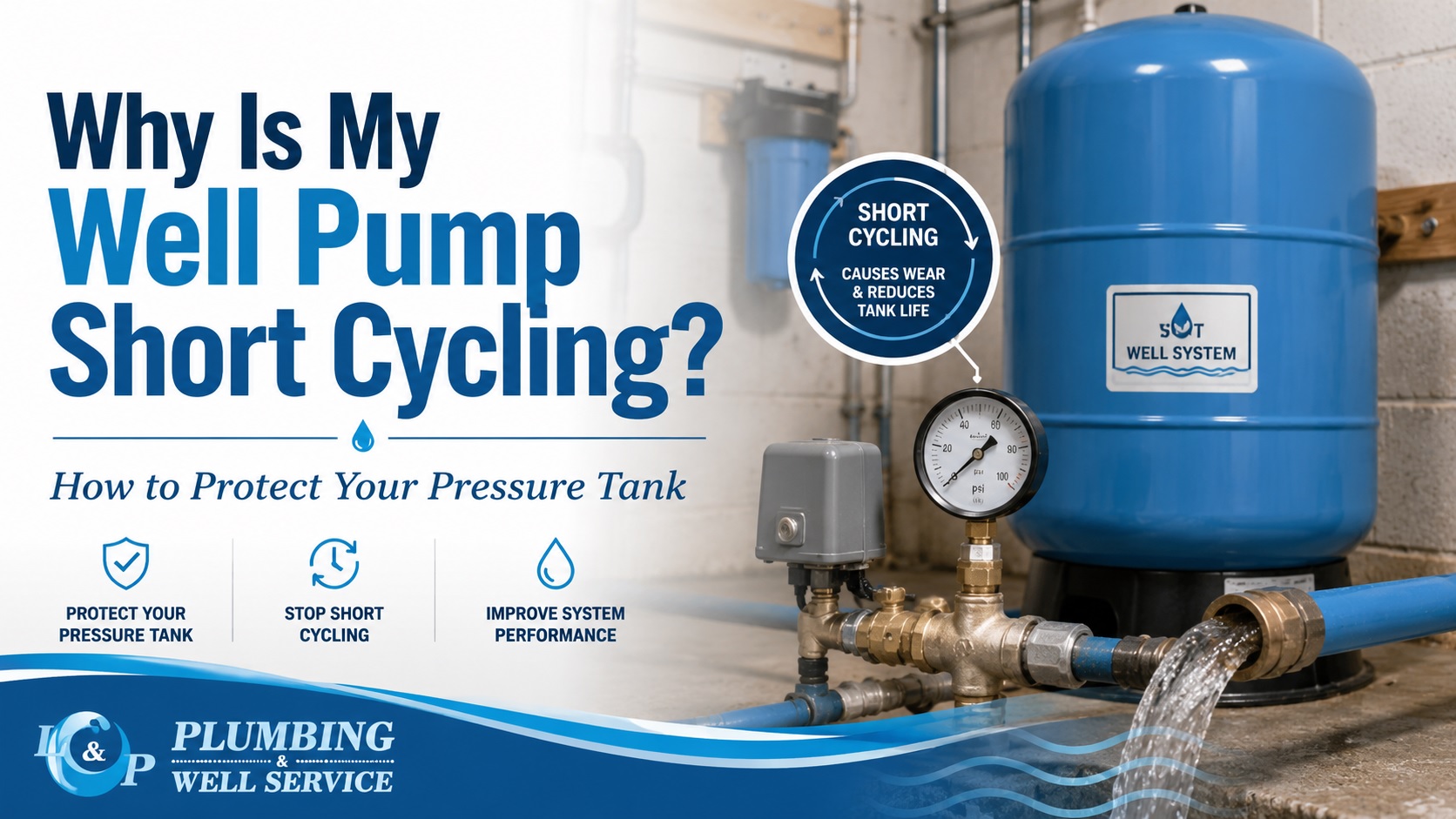
For homeowners across Watertown, Torrington, Litchfield, Thomaston, Waterbury, Middlebury, Woodbury, Bethlehem, Goshen, Harwinton, Burlington, and nearby Connecticut towns, well pump short cycling is one of the clearest warning signs that a private well system needs attention. At L&P Plumbing & Well Service, our team sees this issue often: the pump clicks on, shuts off, then turns back on again after only a short burst of water use.
That rapid on-off pattern is not normal. It can burn out a pump motor, damage electrical controls, strain the pressure switch, and leave the home dealing with low water pressure in house fixtures.
What Does Well Pump Short Cycling Mean?
Well pump short cycling means the pump is starting and stopping too often. A healthy well system should build pressure, shut off, and then allow the pressure tank to supply water before the pump starts again.
When the pump turns on every few seconds or every minute, the tank is not storing enough usable water between cycles. That puts the pump under constant stress.
Common symptoms include:
- Clicking sounds near the pressure switch
- Pressure gauge rising and dropping quickly
- Water pressure pulsing at faucets
- Pump turning on after small water use
- Low water pressure in house fixtures
- Pump breaker tripping
- No water after repeated cycling
The Pressure Tank’s Role
The pressure tank is the buffer between the well pump and the home’s plumbing. Modern bladder-style tanks use an air chamber and internal bladder to hold pressurized water. This stored pressure lets faucets, showers, toilets, washing machines, and dishwashers run without forcing the pump to start every time water is used.
We also provide well water tank services for homeowners who need pressure tank inspection, replacement, or full system evaluation.
How to Check the Pressure Gauge
A pressure gauge can give helpful clues. Most residential systems run on a pressure switch range such as 30/50 or 40/60 PSI. With a 30/50 setup, the pump turns on near 30 PSI and shuts off near 50 PSI. With a 40/60 setup, it turns on near 40 PSI and shuts off near 60 PSI.
Watch the gauge while water is running. If pressure drops quickly, the pump starts, pressure rises fast, then the pump shuts off almost immediately, the pressure tank may be waterlogged, undercharged, or damaged.
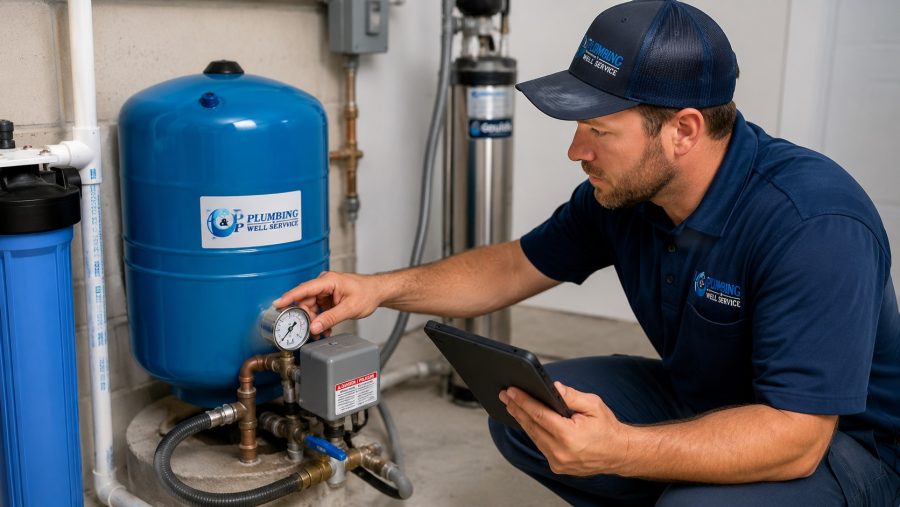
Simple Adjustment or Emergency Replacement?
Some short cycling issues are simple. Others point to a failing tank or pump.
A pressure switch adjustment may help when:
- The gauge readings are slightly off
- The switch is old but still functioning
- Contacts are worn or dirty
- The tank still holds air properly
- The system pressure range needs correction
Emergency replacement may be needed when:
- Water comes out of the tank’s air valve
- The bladder has failed
- The tank will not hold air
- The pump cycles every few seconds
- The pressure switch is arcing or burned
- The pump overheats or loses prime
- The home has no water or severe pressure loss
For urgent pump problems, schedule a well pump repair in Watertown CT.
The Safe Way to Check Tank Air Charge
Homeowners can observe the system, but electrical and pressure adjustments should be handled carefully. Before checking tank air charge, power must be shut off and the tank must be drained.
The basic concept is this: the tank’s air charge should usually be set 2 PSI below the pressure switch cut-in setting. For example, a 30/50 switch often needs a 28 PSI tank charge when the tank is empty. A 40/60 switch often needs a 38 PSI tank charge when empty.
If the tank is not empty, the reading will be wrong. If the pressure switch is adjusted without matching the tank charge, short cycling can get worse.
Why Low Water Pressure Can Be Connected
Low water pressure in house plumbing is not always caused by the pump itself. The issue may come from the pressure tank, pressure switch, clogged filters, sediment, undersized equipment, a failing pump, or a hidden leak.
L&P Plumbing also provides well water filtration and well water treatment for homes dealing with sediment, staining, odor, or quality concerns that can affect overall system performance.
Why Sean and Jerry Look at the Whole System
A short cycling call should not end with a guess. The right diagnosis looks at the pump, tank, pressure switch, gauge, wiring, check valve, water demand, filtration, and plumbing distribution.
At L&P Plumbing & Well Service, Sean and Jerry bring owner-operated experience to well system service. That matters because private wells are not one-size-fits-all. A deep well, shallow well, older galvanized tank, modern bladder tank, large family, irrigation demand, or sediment-heavy water supply can all change the repair plan.
For homes needing full replacement, well pump installation should include pump sizing, tank performance, water demand, and system testing.
Protect the Pump Before It Fails
Well pump short cycling is a warning sign that should not be ignored. Sometimes the fix is a pressure adjustment. Sometimes the pressure tank, switch, or pump needs replacement. The only way to know is to test the system correctly.
We help Connecticut homeowners restore steady water pressure, protect pressure tanks, and prevent pump failure. Schedule service through L&P Plumbing & Well Service before short cycling turns into a no-water emergency.
FAQ
Why does my well pump keep turning on and off?
The most common causes are a waterlogged pressure tank, lost tank air charge, bad pressure switch, clogged switch tube, plumbing leak, or failing pump.
Can a pressure tank cause low water pressure in house fixtures?
Yes. If the tank cannot store pressure properly, water pressure may pulse, drop quickly, or feel weak at faucets and showers.
Is well pressure tank troubleshooting safe for homeowners?
Homeowners can watch the pressure gauge and note symptoms. Power, wiring, pressure switch adjustment, and tank replacement should be handled by a qualified well service professional.
How fast can short cycling damage a pump?
Rapid cycling can shorten pump life quickly because the motor is forced to start repeatedly. Pump motors work hardest during startup.