
Connecticut homeowners planning a water heater, furnace, boiler, well tank, or major plumbing replacement need to understand one thing before buying equipment: code compliance can change the real project cost.
As of the latest official Connecticut Department of Administrative Services update, the 2022 Connecticut State Building Code remains the current code for permit applications, while the next state building, fire safety, and fire prevention codes were expected for July 1, 2026 but may be delayed pending Legislative Regulation Review approval. That makes 2026 a critical planning year for homeowners looking at Connecticut building code updates 2026.
What Connecticut Homeowners Need to Know About the 2026 Code Transition
The proposed 2026 Connecticut State Building Code includes amendments to the 2024 International Plumbing Code. The proposed plumbing section states that it applies to plumbing installation, alteration, repair, relocation, replacement, addition, use, and maintenance across Connecticut. It also states that gas-fired water heaters and water heater venting systems are regulated through referenced fuel gas provisions.
For homeowners, that means a water heater replacement is not just “swap the tank.” A compliant installation may involve permit filing, vent review, expansion control, pressure checks, shutoff updates, drip pan requirements, discharge piping, combustion air review, and inspection.
Plumbing Permit Requirements Connecticut Homeowners Should Expect
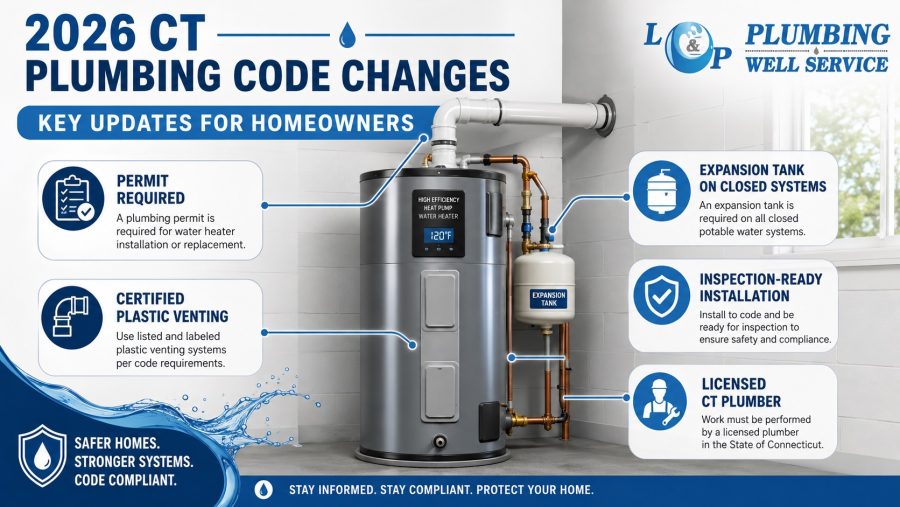
The proposed code language says an owner or authorized agent must apply to the building official and obtain the required permit before installing, replacing, altering, repairing, removing, or converting a plumbing system regulated by the code.
That matters during resale. Unpermitted plumbing work can create inspection problems, buyer concerns, insurance issues, and municipal correction orders. A cheap installation can become expensive later if a buyer’s inspector finds missing permits, unsafe venting, missing safety controls, or noncompliant water heater piping.
Water Heater Expansion Tank Code CT: Why Closed Systems Matter
One of the most common surprise add-ons is a thermal expansion tank. The 2024 International Plumbing Code section on thermal expansion control states that a thermal expansion control device must be connected to the water heater cold water supply pipe downstream of check valves.
In plain terms, when a home has a closed water system, heated water cannot safely expand backward into the public water supply. A check valve, backflow preventer, or pressure-reducing valve can trap that expanding water inside the home’s plumbing. Without an expansion tank or approved control device, pressure can stress the water heater, fixtures, valves, supply lines, and relief valve.
That is why water heater expansion tank code CT questions often come up after a homeowner receives a quote. The tank itself is not just an accessory. It is a pressure-control component that helps the system pass inspection when the home setup requires it.
Plastic Exhaust Venting: Why Standard Pipe May Not Be Enough
High-efficiency gas appliances often exhaust through plastic venting because their flue temperatures are lower than older chimney-vented systems. The challenge is that combustion exhaust can include acidic condensate, positive pressure, and carbon monoxide risk.
UL explains that UL 1738 covers venting systems for Categories II, III, and IV gas-burning appliances, and that these systems are designed for special conditions where efficient appliances may create condensation and require corrosion-resistant, tested venting. UL also notes that NFPA 54 allows certain nonmetallic venting approaches when the appliance is listed for the material or when the venting system is listed and labeled under UL 1738.
That is where a big-box water heater or furnace purchase can mislead homeowners. The appliance box may not include every venting, support, condensate, combustion air, and safety detail needed for a legal Connecticut installation. A licensed CT plumber reviews the existing vent route, manufacturer instructions, pipe labeling, termination location, and inspection expectations before connecting the unit.
Why Licensed Installation Protects the Home
A compliant replacement protects more than hot water. It protects the future sale of the property, the municipal record, appliance warranty expectations, and family safety.
A licensed installation can include:
- Permit coordination with the local building department
- Proper water shutoff and supply piping
- Thermal expansion control where required
- Temperature and pressure relief valve discharge piping
- Safe venting for gas-fired equipment
- Combustion air and clearance review
- Leak testing and operational checks
- Inspection-ready documentation
L&P Plumbing & Well Service is not a volume-only installer. Our local team provides custom assessments, water pressure checks, filtration insight, well system knowledge, and plumbing service built around long-term reliability. We highlighted how properly installed water systems help protect plumbing fixtures, water heaters, and appliances from sediment and mineral damage.
Code Costs Less Than Corrections
The safest way to navigate connecticut building code updates 2026 is to plan before the old appliance fails. A standard store-bought unit may look affordable, but the real installation must satisfy plumbing permit requirements connecticut homeowners face at the municipal level.
For water heater expansion tank code ct questions, venting concerns, well system pressure issues, or full plumbing replacement planning, L&P Plumbing & Well Service can help homeowners choose the right equipment, install it correctly, and prepare the job for inspection.