
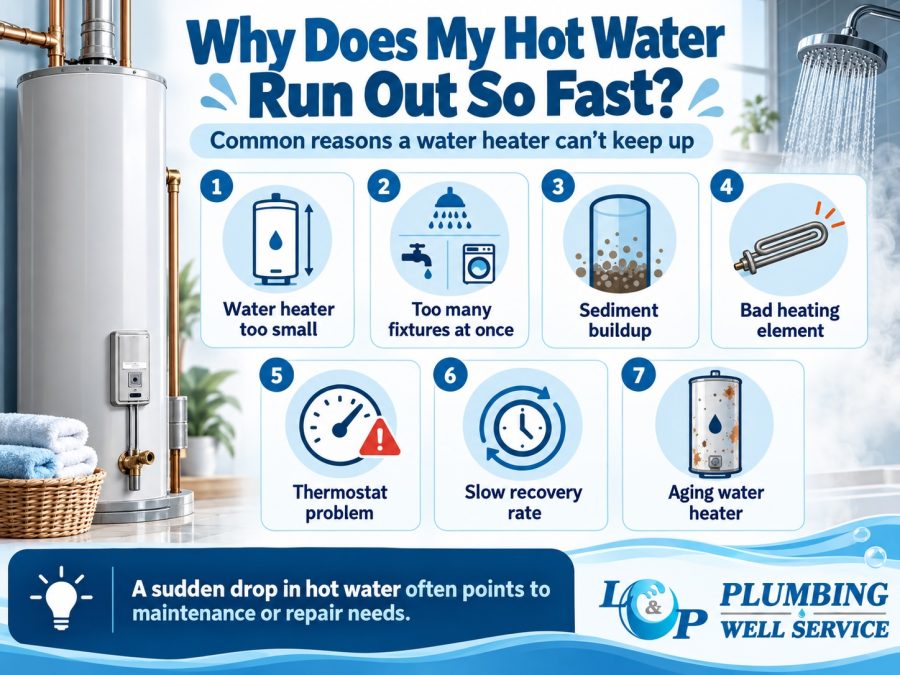
When hot water runs out quickly, the cause may be heavy household demand, an undersized water heater, sediment buildup, failing heating components, thermostat problems, or reduced recovery performance. Tank-style systems also have a limited amount of immediately available hot water. If the problem is new or getting worse, we recommend diagnosing the heater before assuming a larger replacement is necessary.
Few plumbing problems are more frustrating than starting with a hot shower and suddenly getting cold water halfway through.
At L&P Plumbing & Well Service, we look at more than tank size when homeowners in Watertown and surrounding Connecticut communities tell us their hot water runs out quickly. The problem may involve water usage, sediment, heating components, recovery rate, or the condition of the water heater itself.
Why Does My Hot Water Run Out So Fast?
A storage water heater has two jobs: keep a certain volume of water hot and heat replacement water as hot water leaves the tank.
The Department of Energy uses First-Hour Rating, or FHR, to describe how much hot water a storage water heater can supply during an hour that begins with a fully heated tank. FHR depends on tank volume and how quickly the burner or heating elements can recover.
That means a 50-gallon tank does not automatically deliver exactly 50 gallons of usable hot water before temperatures begin falling.
1. The Water Heater Is Too Small for Household Demand
Sometimes the heater works correctly but household demand has outgrown its capacity.
Common examples include:
- Several showers back to back
- Showers running while laundry is washing
- Dishwasher use during morning or evening demand
- A growing household
- Larger tubs or high-flow shower fixtures
- New fixtures that use more hot water
Water-heater sizing should account for peak demand, not just the number printed on the tank.
The Department of Energy recommends using first-hour performance when evaluating storage water-heater capacity.
2. Too Many Fixtures Are Using Hot Water at Once
Even a properly sized heater can struggle when several fixtures demand hot water simultaneously.
A shower, dishwasher, kitchen faucet, and washing machine may collectively use heated water faster than a storage system can recover.
One useful test is to compare performance during low demand.
If one shower stays hot when no other fixtures are running but runs cold during busy periods, total household demand may be exceeding the heater’s recovery capability.
3. Sediment Has Built Up Inside the Tank
Sediment is especially relevant for Connecticut homes with hard water, mineral-rich water, or private wells.
Calcium, magnesium, sand, iron, and other particles can settle inside a storage tank. L&P notes that heavy sediment can interfere with normal heating performance and make homeowners notice that hot water runs out faster.
Other sediment warning signs may include:
- Popping
- Rumbling
- Crackling
- Slower recovery
- Reduced hot-water performance
Our guide to how often a water heater should be flushed explains how mineral buildup affects tank-style equipment.
4. An Electric Heating Element May Be Failing
Electric tank water heaters commonly use more than one heating element.
If one element stops operating correctly, the heater may still produce some hot water, which can make the problem less obvious than a complete failure.
Homeowners may notice:
- Hot water starts normally but disappears quickly
- Recovery takes much longer
- Water never feels as hot as before
- Performance varies throughout the day
L&P lists inadequate hot water and temperature fluctuations among the water-heater problems the company diagnoses and repairs.
Testing heating elements involves electrical equipment and should be handled safely.
5. The Thermostat or Temperature Control Is Not Working Correctly
A thermostat problem can prevent the water heater from reaching or maintaining its intended temperature.
The result can feel like reduced capacity because less truly hot water is available to mix with cold water at faucets and showers.
Temperature problems can also involve controls, wiring, heating elements, gas components, or other equipment depending on the type of heater.
We recommend diagnosing the cause instead of continually raising temperature settings.
6. The Water Heater Is Recovering Too Slowly
Recovery rate describes how quickly the system can heat replacement water after hot water has been used.
Recovery can decline because of:
- Sediment buildup
- Worn heating elements
- Burner problems
- Control problems
- Aging equipment
- Heavy demand
- Incoming cold-water temperature
Connecticut winter conditions can make recovery demands more noticeable because incoming water may be colder.
A heater that once kept up with consecutive showers but suddenly cannot deserves inspection.
7. The Water Heater May Be Aging
Water-heater performance can decline as components wear and sediment accumulates.
Age alone does not prove that replacement is necessary. We first look at tank condition, heating performance, leaks, corrosion, controls, sediment, and repair history.
Warning signs that deserve closer attention include:
- Rusty or discolored hot water
- Water around the tank
- Frequent repair needs
- Loud recurring noises
- Significant corrosion
- Very slow recovery
- Unreliable temperatures
L&P provides troubleshooting, repair, replacement, and installation for both storage and tankless water heaters throughout the Watertown area.
What About Tankless Water Heaters?
Tankless systems heat water on demand rather than storing a fixed tankful.
That can eliminate the traditional problem of emptying a storage tank, but tankless equipment still has a maximum flow capacity. The Department of Energy notes that tankless systems supply hot water at a rated gallons-per-minute output, meaning several simultaneous fixtures can still exceed what the unit can heat effectively.
So “endless hot water” does not mean unlimited hot-water flow.
Should We Repair or Replace the Water Heater?
Repair often makes sense when the tank is structurally sound and the problem involves a serviceable element, thermostat, burner component, maintenance issue, or another replaceable part.
Replacement becomes more reasonable when the tank is deteriorating, leaking, repeatedly failing, substantially undersized, or no longer economical to repair.
Our water heater repair and installation services cover diagnosis, maintenance, repair, tank replacement, and tankless options for Watertown and Litchfield County homes.
Get the Cause Diagnosed Before Buying a Bigger Tank
When hot water suddenly starts running out faster, replacing the heater with a larger model is not always the answer.
We first look at usage, first-hour capacity, sediment, heating components, recovery performance, water quality, and the age of the equipment.
L&P Plumbing & Well Service serves Watertown, Litchfield County, New Haven County, and nearby Connecticut communities with owner-operated plumbing and water-heater service.
Schedule a water-heater inspection when hot water capacity drops unexpectedly or the system can no longer keep up with normal household demand.
Frequently Asked Questions
Why does my hot water run out after 10 minutes?
Possible causes include an undersized tank, heavy demand, sediment buildup, a failed electric heating element, thermostat problems, or slow recovery.
Can sediment make hot water run out faster?
Yes. Heavy sediment can interfere with normal heating performance and reduce effective hot-water availability.
Why did my water heater suddenly start running out faster?
A sudden change points more toward a developing equipment problem than normal capacity. Heating elements, controls, sediment, burner performance, or other components may need inspection.
Will a bigger water heater solve the problem?
Only when capacity is actually the issue. A larger tank will not correct a failed element, excessive sediment, thermostat problem, or other malfunction.
Can a tankless heater run out of hot water?
A tankless heater does not empty like a storage tank, but its heating capacity is limited by flow rate. Too many simultaneous fixtures can exceed the unit’s output.