
When the shower suddenly turns cold, the first question is usually simple: why is my hot water not working? For many Connecticut homeowners with an electric water heater, one possible answer is a burned-out heating element.
At L&P Plumbing & Well Service, our team handles water heater repair, water heater installation, well service, plumbing repairs, repiping, fixtures, sump pumps, and full home water system support for Watertown and surrounding Connecticut communities. The company’s water heater page lists common repair concerns such as inadequate hot water, temperature fluctuations, and water heater issues, while the locations page lists service across Watertown, Bethlehem, Goshen, Harwinton, Litchfield, Middlebury, New Hartford, Torrington, Winchester, Wolcott, Woodbury, Waterbury, Burlington, and Thomaston.
For homeowners searching electric water heater troubleshooting, this guide explains the warning signs, what the upper and lower elements do, what else can cause cold water, and why a professional hot water heater repair contractor should handle electrical testing and replacement.
First, What Does a Water Heater Element Do?
An electric tank water heater uses heating elements inside the tank to warm the stored water. Many residential electric models have two elements, one near the top and one near the bottom. The lower element usually does most of the daily heating, while the upper element helps recover hot water near the top of the tank.
A.O. Smith’s electric water heater service materials explain that heating elements convert electrical energy into heat energy, while Lowe’s notes that failed heating elements can cause insufficient hot water or no hot water at all.
When one element burns out, the tank may still produce some warm water. When both fail, the home may have no hot water at all.
Signs Your Water Heater Element May Be Burned Out
A burned-out electric water heater element may cause:
- Lukewarm water instead of hot water
- Hot water that runs out much faster than normal
- A tank that takes too long to recover
- Hot water only at certain times of day
- A breaker that trips after the water heater runs
- No hot water even though the tank has power
- Normal cold water pressure but no heating performance
These symptoms do not always mean the element is the only problem. Thermostats, breakers, wiring, sediment buildup, tank age, and water heater size can create similar issues. That is why professional diagnosis matters.
Upper Element vs. Lower Element: Why the Symptoms Feel Different
Electric water heater troubleshooting starts with understanding which part of the tank is failing.
When the Upper Element Fails
The upper element heats the water near the top of the tank. Since hot water leaves from the top, a failed upper element can cause little to no hot water. The tank may feel like it never fully starts heating.
Common signs include:
- No hot water at any fixture
- Water that stays cold even after waiting
- Reset button issues
- A system that appears powered but does not recover
When the Lower Element Fails
The lower element heats most of the tank volume. When it fails, the upper part may still heat a small amount of water, but the tank runs out quickly.
Common signs include:
- A short burst of hot water
- Lukewarm water after one shower
- Hot water that runs out twice as fast as before
- Slow recovery between showers
- More noticeable issues during laundry, dishwashing, or back-to-back use
This is why some homeowners say, “the water gets hot, but not for long.” That often points toward a lower element, thermostat issue, sediment problem, or tank capacity issue.
The Homeowner Safety Check: What Can Be Looked At First
Before assuming the element is burned out, homeowners can safely observe a few non-invasive clues.
Check these items without removing electrical panels:
| What to Check | What It May Mean |
|---|---|
| Hot water at all fixtures | A whole-home issue usually points to the water heater, not one faucet |
| Breaker position | A tripped breaker may cut power to an electric unit |
| Tank age | Older units may have worn elements, sediment, or tank failure |
| Visible leaks | A leaking tank may need replacement, not element repair |
| Recent usage | Multiple showers can temporarily drain a properly working tank |
| Water temperature pattern | Fast hot water loss may suggest lower element trouble |
Avoid removing access panels, touching wires, draining the tank, or testing components unless trained. Electric water heaters commonly use high-voltage electrical connections. Rheem safety materials for electric water heaters warn that removing covers can expose live wiring and that service should be handled by a qualified person.
Why 240-Volt Water Heater Work Requires Professional Hands
A burned-out element sounds like a simple part swap, but the repair involves electricity, water, pressure, and tank components. That mix is not forgiving.
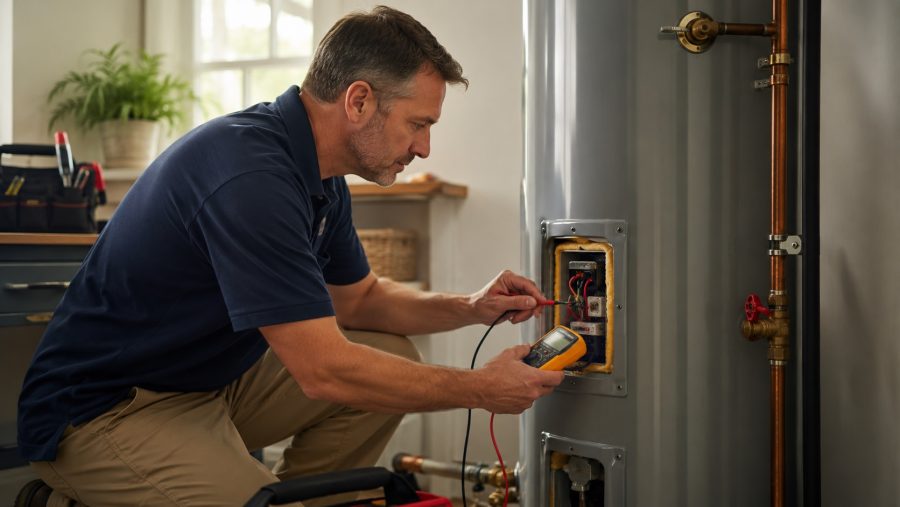
A professional technician may need to:
- Confirm power supply
- Test thermostats
- Test upper and lower elements
- Verify voltage and wattage requirements
- Shut down power safely
- Drain water to the proper level
- Remove the failed element
- Inspect for corrosion or sediment
- Install the correct replacement part
- Restore the system and test recovery
The risk is not just shock. A wrong part, loose connection, dry-fired element, damaged gasket, or improper reset can lead to repeat failure, leaks, breaker trips, or unsafe operation.
That is why L&P Plumbing & Well Service recommends calling a water heater repair contractor when hot water suddenly disappears.
What Else Can Cause No Hot Water?
Not every no-hot-water call is a burned-out element. A good diagnosis looks at the full system.
1. Tripped Breaker
If the breaker trips once, the water heater may stop heating. If it trips repeatedly, there may be an electrical fault, failed element, thermostat issue, or wiring concern.
2. Bad Thermostat
Each element is controlled by a thermostat. A failed thermostat may keep a good element from turning on.
3. Sediment Buildup
Minerals can settle at the bottom of the tank. That buildup can reduce heating efficiency, create popping noises, and strain the lower element.
4. Undersized Tank
If the household has grown or usage has changed, the unit may not be large enough. This is common when more people are showering, laundry runs often, or fixtures have been added.
5. Aging Water Heater
A repair may make sense for a newer unit. For an older tank with leaks, rust, frequent failures, or poor recovery, replacement may be the better long-term option.
6. Well Water Conditions
Homes on well water may have minerals, sediment, or water quality issues that affect plumbing fixtures and water heater performance. L&P Plumbing & Well Service also provides well water treatment, well water tanks, well water filtration, and well pump repair for homes that need full water system support.
Water Heater Element Replacement Cost: What to Expect
The keyword most homeowners search next is water heater element replacement cost. National pricing sources place professional water heater element repair commonly around the low hundreds. Angi lists professional water heater element repair at about $200 to $300, while Homewyse estimates general hot water heater repair starting around $303 to $365 per heater, depending on site conditions and options.
Actual cost can vary based on:
- Number of elements being replaced
- Thermostat condition
- Water heater access
- Tank age
- Corrosion around the element
- Sediment inside the tank
- Emergency service timing
- Local labor and parts availability
- Whether repair or replacement is the smarter choice
At L&P Plumbing & Well Service, our goal is honest diagnosis. If a water heater can be repaired safely and reliably, that option deserves consideration. If the tank is leaking, severely corroded, or near the end of service life, replacement may protect the home from repeat calls and water damage.
When to Repair vs. Replace the Water Heater
A burned-out element does not always mean the whole water heater needs to go. Many element failures are repairable. The bigger question is whether the tank is still worth investing in.
Repair May Make Sense When:
- The water heater is newer
- The tank is not leaking
- Only one element failed
- The unit has served the home well
- Parts are available
- The tank size still fits household demand
Replacement May Make Sense When:
- The tank is leaking
- The unit is older
- Both elements and thermostats are failing
- Recovery has been poor for a long time
- Rusty water appears from hot fixtures
- Repairs are becoming frequent
- The household needs more hot water capacity
Lowe’s notes that water heater life expectancy is often about 8 to 12 years, though actual lifespan depends on installation, water quality, location, design, and maintenance.
A Simple Diagnostic Timeline for Homeowners
Here is a safe way to think through the problem before calling.
Step 1: Confirm the Problem
Check whether every hot fixture is affected. If only one shower is cold, the issue may be a fixture, cartridge, or mixing valve rather than the water heater.
Step 2: Note the Pattern
Does the water stay cold? Does it get lukewarm? Does it start hot and run out fast? This pattern helps identify whether the upper element, lower element, thermostat, sediment, or tank size may be involved.
Step 3: Check for Visible Leaks
Look around the base of the tank without touching wiring or opening panels. Any active leak should be treated seriously.
Step 4: Look at the Breaker
A tripped breaker can explain a no-hot-water issue. If it trips again after being reset, stop and call a professional.
Step 5: Call a Licensed Plumber
When the issue points to elements, thermostats, wiring, or tank failure, schedule professional service. L&P Plumbing & Well Service provides water heater service for Watertown and surrounding communities.
Why Fast Water Heater Repair Builds Long-Term Protection
No hot water is disruptive, but it can also be a helpful warning. A small repair call may reveal early signs of sediment, corrosion, pressure issues, undersized equipment, or water quality concerns before they become larger plumbing problems.
That is why our team looks beyond the single symptom. A failed element may be the immediate issue, but the cause may include hard water, sediment, age, electrical wear, or household demand.
For homes needing broader support, L&P Plumbing & Well Service also handles repiping, fixture service, sump pumps, and well system repairs. One service visit can help homeowners understand the condition of the entire water system.
The Warm Shower Test: What Your Water Heater Is Telling You
A water heater rarely fails at a convenient time. The first cold shower is often the first clue that something inside the tank has changed. If the water is lukewarm, runs out too fast, or never heats at all, the heating element may be burned out, but a professional diagnosis is the safest way to know.
At L&P Plumbing & Well Service, our team helps homeowners get hot water back with honest troubleshooting, practical repair options, and dependable water heater service. Schedule water heater repair in Watertown, CT or explore our full plumbing services for help with leaks, fixtures, repiping, sump pumps, well pumps, and full home water solutions.
FAQs
Why is my hot water not working?
Your hot water may not be working because of a tripped breaker, burned-out heating element, failed thermostat, sediment buildup, tank leak, or aging water heater. For electric units, heating elements are a common cause of lukewarm water or no hot water.
How do you know if a water heater element is burned out?
Common signs include lukewarm water, hot water that runs out quickly, slow recovery, repeated breaker trips, or no hot water even when the tank has power. A professional can test the upper and lower elements safely.
Can one bad element cause no hot water?
Yes. If the upper element fails, the tank may produce little to no hot water. If the lower element fails, the tank may produce a short amount of hot water before turning lukewarm or cold.
What is the average water heater element replacement cost?
Professional water heater element replacement often falls in the low hundreds, but the final cost depends on the number of elements, access, tank condition, thermostat issues, corrosion, and local labor. A technician should confirm the problem before replacing parts.
Is it safe to replace a water heater element yourself?
Water heater element replacement involves electrical connections, water, pressure, and tank components. Since electric water heaters can involve high-voltage circuits, professional service is the safer choice for most homeowners.
Who should homeowners call for hot water heater repair in Watertown, CT?
Homeowners in Watertown and surrounding Connecticut towns can call L&P Plumbing & Well Service for water heater repair, water heater replacement, plumbing repairs, well pump service, water treatment, and full home water system support.